Showing posts with label Catharine Maria Sedgwick. Show all posts

March 28, 2014

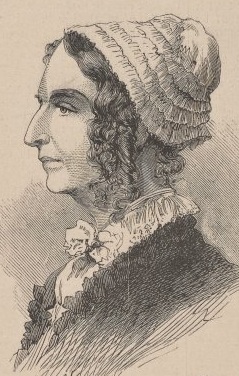
Catharine Sedgwick: to pour a golden light

Nevertheless, my dearest sister, I would not have you love me any less than you do, because your affection has an irresistible power to improve and to elevate, to lift above low attachments, to separate from unworthy associations, to cheer me when I am sad, to rouse me when I am inefficient, to rescue both me and the world from that sort of morbid quarrel into which we are apt to get with each other, when it seems as if there were nothing here worth living for, and to pour a golden light on every object that skirts the path of my pilgrimage.


The above quote comes from a letter from Robert Sedgwick to his sister, the author Catharine Maria Sedgwick, March 28, 1816. Miss Sedgwick, as she was often named, was then about 26 years old, had already begun submitting short contributions to periodicals. She was still six years away from her first novel, A New-England Tale (1822), and 11 years away from her most popular work, Hope Leslie (1827). These works and various others made her one of the first financially successful women writers in the United States — and one of the most popular.

Much of Sedgwick's writings promoted virtue, religious tolerance, and strong roles for women. She never married and remained quite devoted to her large family (she was the ninth child in the family). Her four brothers supported her work as a writer and encouraged her to publish when she was just starting. Throughout her life, she alternated living with her brother Charles in western Massachusetts and with her brother Robert in New York City. In fact, she dedicated her fourth novel, Clarence; Or, a Tale of Our Own Times (1830), "To my Brothers — my best friends... as a tribute of affection." As she was completing the novel, she wrote to her brother Charles that she was unsatisfied with it: "That is the misfortune of a familiarity with fine works, carrying your taste so far ahead of your capacity."

When she reissued Clarence nearly two decades later, Sedgwick admitted that popularity, and novels in particular, were "ephemeral." She hoped, nevertheless, readers would enjoy the "home atmosphere" of this novel of manners set in New York. More than that, Sedgwick had written a book that questioned the development of American society, concerned that there was less concern for spiritual or social responsibilities in a world that emphasized profit and materialism.

November 25, 2012

Sedgwick: the feeling of the times

On November 25, 1841, Catharine Maria Sedgwick reflected on her success as a writer in an informal account book. She noted that her 1835 novel The Linwoods sold 4,300 copies of its original print run of 5,000 within a year (a number which doubled typical sales figures, according to publisher George Palmer Putnam). It remains one of her most popular works, after the earlier novel Hope Leslie.

The Linwoods; or, 'Sixty Years Since' in America was set during the American Revolution but published, as the subtitle suggests, about six decades after that conflict (the subtitle also references Sir Walter Scott). As Sedgwick writes in her preface:

The writer has aimed to exhibit the feeling of the times, and to give her younger readers a true, if a slight, impression of the condition of their country at the most—the only suffering period of its existence, and by means of this impression to deepen their gratitude to their patriot-fathers; a sentiment that will tend to increase their fidelity to the free institutions transmitted to them. 

Despite the setting, Sedgwick chose to ignore most of the historic events and war-related details, though General Lafayette makes an appearance. Amid this period of conflict (apparently Sedgwick believed the "only suffering period"), the titular Linwood family are loyalists who remain dedicated to the King of England. The next generation of Linwoods, however, question that loyalty, including a daughter named Isabella, who becomes the main heroine of the story.

Isabella (and, ultimately, Sedgwick herself) questions her place in the status quo, not only in the form of revolution from England, but also in the role of women and blacks in the New World. Her friend Rose, an enslaved black woman, believes it as merely a beginning: "Can't you see these men are raised up to fight for freedom for more than themselves? If the chain is broken at one end, the links will fall apart sooner or later." The Linwoods was an immediate success; contemporaries referred to it as a "charming tale of home life." Sedgwick did not publish another novel until 22 years later.

*I am entirely indebted to James L. Machor for much of the information in this post, found in his Reading Fiction in Antebellum America: Informed Response and Reception Histories, 1820-1865 (2011). Further information comes from Catherine Maria Sedgwick: Critical Perspectives (2002), edited by Lucinda Damon-Bach and Victoria Clements.

July 6, 2011

Extravagant praise of Hope Leslie

On July 6, 1827, Catharine Maria Sedgwick wrote to her brother:

I hear from all quarters what honestly seems to me very extravagant praise of 'Hope Leslie.' I trust I shall not be elated by it. At present I certainly am not, for I feel too heavily oppressed, too firmly grappled to the earth to mount in the balloon of vanity.

Sedgwick had published Hope Leslie earlier that year, a novel set during the early European settlement of New England. The title character and her sister Faith had moved in with a relative named Fletcher after the death of their parents. Assigned to the Fletcher household was Magawisca, a teenage girl who had been captured from the Pequod tribe. When her father, the chief of the tribe, comes to rescue her, he also captures Everell Fletcher and Faith Leslie (hope's sister). Her father prepares to execute Everell by publicly chopping off his head, but Magawisca intervenes:

Everell bent forward and pressed his forehead to the rock The chief raised the deadly weapon, when Magawisca, springing from the precipitous side of the rock, screamed "Forbear!" and interposed her arm. It was too late. The blow was levelled—force and direction given; the stroke, aimed at Everell's neck, severed his defender's arm, and left him unharmed. The lopped, quivering member dropped over the precipice.

Everell escapes and, over the years, Faith integrates into the tribe and marries Magawisca's brother. When Magawisca is falsely accused of conspiring against whites, Everell and Hope Leslie help her escape.

The novel was the most widely-read of Sedgwick's works; the author, however, seemed disinterested by its success. When friends told her it would bring her fame, she wrote: fame—what is it? the breath of man." She prayed that she would "resist pride, vanity, egotism, self-complacency, and all those selfish propensities and emotions... May I remember that the talent... is the gift of God."

December 28, 2010

Birth of Catharine Maria Sedgwick


Catharine Maria Sedgwick was born in Stockbridge, Massachusetts on December 28, 1789. She became a popular writer, particularly through her novel Hope Leslie (1827). In a letter describing her childhood recollections, Sedgwick recounted the story of her birth:

I was born... in 1789, December 28th, in a bitter cold night, as I have heard my Aunt Dwight say, who was present on the occasion... I came into the world two months before I was due... I believe... that the people who surround us in our childhood, whose atmosphere infolds us, as it were, have more do with the formation of our characters than all our didactic and preceptive education.

In her novels, Sedgwick often depicted America in its infancy. Her novel The Linwoods (1835), for example, was set during the American Revolution. She also tackled more serious topics, including the ideal relationship between servants and employees. After a few years without publishing, Sedgwick released Married or Single? in 1857. In that book, Sedgwick (who never married) dared to suggest that women should avoid marriage if it would mean a loss of self-respect. She quoted St. Paul: "I say therefore to the unmarried and widows, it is good for them if they abide."

Reviews were mixed. The Albion, for example, claimed that "the tale was designed to plead the case of Spinster-hood. If this were so, the cause is not well pleaded: in fact this object is well-nigh lost sight of." Though Sedgwick presented several examples of "emptiness and wretchedness" in poor marriages, the reviewer wrote, not one example of a happy single woman was presented to show its benefit. On the other hand, a critic in the Ladies Repository called it, "the most thoroughly American, and the most real book I have read in a long while."

*Recommended reading: Catharine Maria Sedgwick: Critical Perspectives, edited by Victoria Clements.

July 31, 2010

Death of Catharine Maria Sedgwick

Only a couple weeks before her death, writer Catharine Maria Sedgwick wrote to a friend that she had been "in a wretched state... I have been very poorly of late." Sedgwick was 77 years old; the major part of her career, including the novel Hope Leslie (1827), were decades behind her. "'Tis hard work," she wrote, "to be sick, helpless and useless!" She died about two weeks later on July 31, 1867.

Modern literary scholar Nina Baym argues that the majority of Sedgwick's fiction depicts a heroine "who has much to teach her readers but nothing to learn herself." Her female protagonists remain unaltered through the events of the novels. It was not until after Sedgwick's first successes, Baym argues, that women characters in American writing undergo a psychological struggle in their inner lives. But, she notes, if Sigourney "had not existed, it would have been necessary to invent her."

Unlike women writers like Lydia Sigourney or even Harriet K. Wilson, Sedgwick did not begin writing for financial need. Instead, her motivation seemed to be boredom. Between 1822 and 1837, she published eight novels (a ninth, Married or Single?, was published in 1857).

Those who praised Sedgwick included Edgar Allan Poe, who declared The Linwoods (1835) the greatest of her works. William Wells Brown renamed a character in an 1864 revision of his novel Clotel after The Linwoods. Rufus Wilmot Griswold praised her style for being "colloquial, picturesque, and marked by a facile grace which is evidently a gift of nature." Nathaniel Hawthorne called her "our most truthful novelist."